
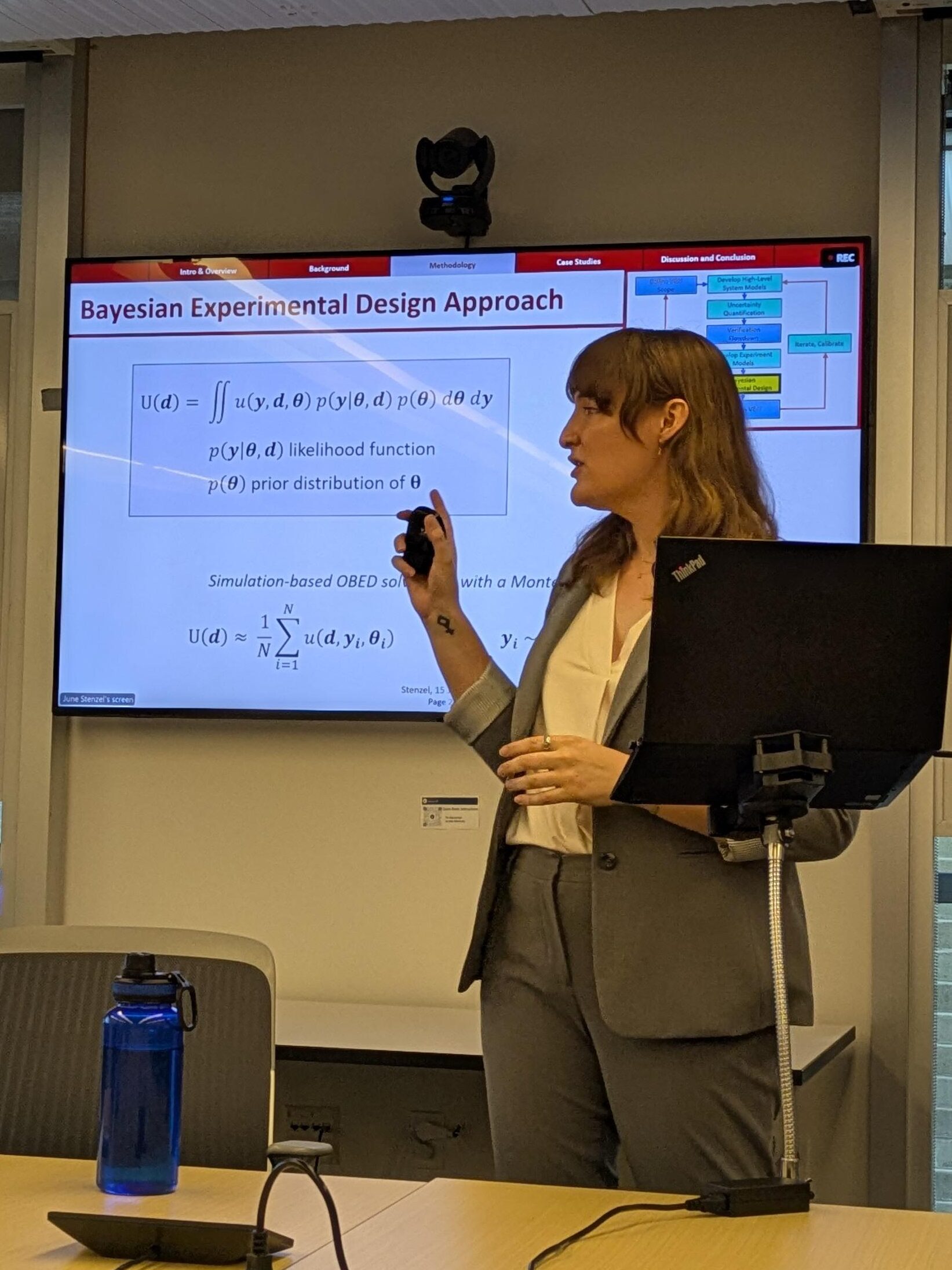
I recently completed my studies at the Massachusetts Institute of Technology in Aeronautics and Astronatuics, receiving my Master’s degree in May 2022 and my PhD in September 2025. My research interests include astronomy & space science, space systems, systems engineering, lunar exploration, and verification & mission assurance. I am currently on the job market for systems engineering, data science, and postdoctoral research positions.
To see more about me, check out my LinkedIn, ResearchGate, or ORCiD profiles, or download my CV.
Recent publications:
- [In preparation] June Stenzel, Robert A. Simcoe, Olivier de Weck, Rebecca Masterson, Youssef Marzouk, Akshata Krishnamurthy, Mark Chodas, “Optimal verification planning for the Large Lenslet Array Magellan Spectrograph,” SPIE Journal of Astronomical Telescopes Instruments and Systems
- Robert A. Simcoe, Gabor Furesz, Rebecca Masterson, June Stenzel, Danielle Frostig, John Piortowski, Mark Egan, Andrew Malonis, Erik Hinrichsen, Michelle Gabutti, Cody Schneller, Sean MacBride, Rongmon Bordoloi, and Michael McDonald “Construction update on the Magellan LLAMAS integral field spectrograph”, Proc. SPIE 12184, Ground-based and Airborne Instrumentation for Astronomy IX, 121840D (29 August 2022); DOI:10.1117/12.2630489
- Herman L. Marshall, Sarah N. T. Heine, Rosemary Davidson, Alan Garner, Eric M. Gullikson, H. Moritz Günther, Christopher Leitz, Rebecca Masterson, Eric D. Miller, June S. Stenzel, William W. Zhang, Rozenn Boissay-Malaquin, Ilaria Caiazzo, Deepto Chakrabarty, Luigi G. Gallo, Ralf K. Heilmann, Jeremy Heyl, Erin Kara, Norbert S. Schulz, “The Globe Orbiting Soft X-ray (GOSoX) polarimeter concept study,” Proc. SPIE 11822, Optics for EUV, X-Ray, and Gamma-Ray Astronomy X, 118220O (23 August 2021); DOI:10.1117/12.2596186
Recent Presentations:
- Akshata Krishnamurthy, Mark Chodas, Bogdan Oaida, Olivier de Weck, June Stenzel, “Integrating Uncertainty Quantification with Traditional Systems Engineering Practices,” JPL Annual Research Poster Day Conference, November 2024
- June Stenzel, Rebecca Masterson, Robert A. Simcoe, “A Model-based Approach for Verification of the Large Lenslet Array Magellan Spectrograph (LLAMAS),” IEEE Aerospace, May 2024 DOI:10.1109/AERO58975.2024.10521313
- June Stenzel, Rebecca Masterson, Youssef Marzouk, Akshata Krishnamurthy, Mark Chodas, “Optimizing verification planning for uncertainty reduction using Bayesian design of experiments,” AIAA SciTech, Jan 2024 DOI:10.2514/6.2024-1852
I began my PhD at MIT in September 2022. As a researcher in the Engineering Systems Laboratory, I worked to explore how uncertainty quantification and modeling could improve systems engineering processes and enable more informed decisionmaking during a time when scientific ambition is growing faster than science budgets.
I received a continutation of my NSTGRO funding in 2023 for the research proposal, “Developing a Verification and Validation Optimization Methodology with Uncertainty Quantification.” During this time, I also participated in a JPL Strategic University Research Partnership program, and I visited the Jet Propulsion Laboratory for a total of five research internships to develop novel systems engineering methods and analytical techniques with applicability to NASA space science missions in mind.
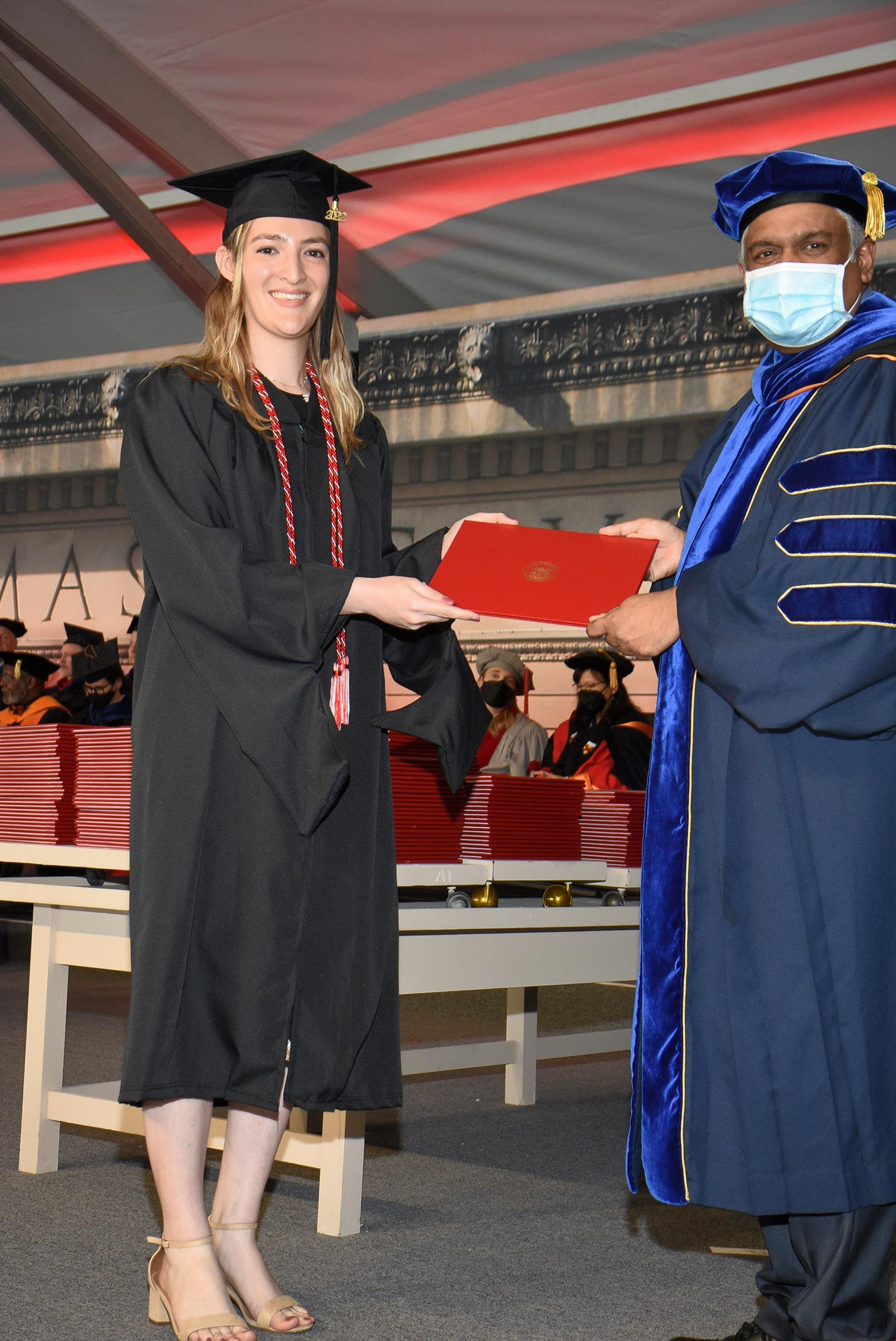
In September 2025, I completed my PhD in Aeronautics and Astronautics with the thesis, “Verification Planning for Efficient Uncertainty Reduction of Space Science Systems.” This dissertation establishes the Uncertainty Quantification Verification Planning Methodology (UQVM), which leverages methods from uncertainty quantification, computational modeling, and optimal Bayesian experimental design to provide a systems engineering methodology for planning verification activities in a cost-efficient and model-informed way. The potential trades and cost savings enabled by UQVM were explored for case studies of space science instrumentation at the component, instrument, and system levels. You can read my PhD thesis here.
I began my Master’s program at MIT in September 2020. In 2021 I was awarded a fellowship by the NASA Space Technology Graduate Research Opportunities program. As a NASA Space Technology Graduate Researcher, I receive funding for my research proposal, “Applying a Model-Based Systems Engineering Approach to Simulation and Testing for Ground and Space Applications.”
During this time, I was a researcher in the Space Systems Lab, and a systems engineer for LLAMAS, the Large Lenslet Array Magellan Spectrograph. LLAMAS is an instrument in development at the MIT Kavli Institute, and will soon be installed on one of the Magellan telescopes at Las Campanas Observatory in Chile.
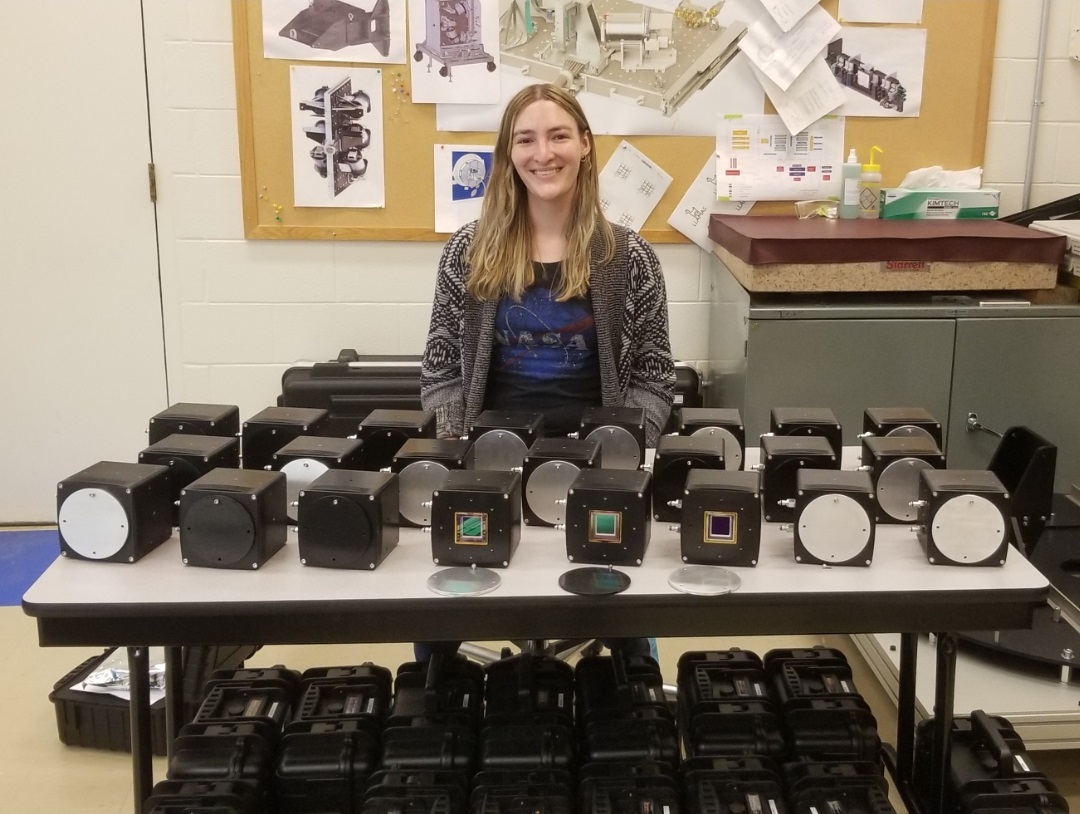
One of my jobs as a member of the Astronomical Instrumentation Team was to test the detectors for the LLAMAS spectrographs. Pictured on the left is me in the lab with most of the LLAMAS CCD’s!
In Spring 2022, I completed my Master’s of Science degree in Aeronautics and Astronautics with the thesis, “Model-Based Verification of the Large Lenslet Array Magellan Spectrograph.” My thesis outlines the challenges of engineering complex science systems and some of the tools and approaches used to manage that complexity, including model-based system engineering (MBSE) methodologies. In the thesis, I propose that targeted use of MBSE for the development of system verification activities can lead to more efficient and effective system engineering. I outline a methodology for model-based verification, and apply it to the LLAMAS integration and testing process. You can read my Master’s thesis here.
Before my career in aerospace engineering, I studied Physics at Texas A&M University. I graduated with a Bachelor’s Degree in Physics, with minors in Math and Astronomy and additional coursework in Computer Science. I graduated with a 4.0 GPA. During that time, I worked as an undergraduate researcher in the Astronomical Instrumentation Lab.
Here are some classes I’ve taken throughout my time in higher education that I particularly enjoyed:
Astrophysical Research Methods ASTR 320, Fall 2015 ASTR 320, Fall 2015 |
Learned about Python scripting, data reduction and error analysis, and computation for astronomical observation. |
| Extragalactic Astronomy ASTR-403, Spring 2016 |
Studied a detailed overview of astronomy, galaxy structure and formation, relativity, and cosmology. Wrote a report describing the timing argument, a famous lower bound on the mass of the Milky Way. |
| High Energy Particle Physics PHYS-489, Fall 2017 |
Studied in-depth the history and physics of the Standard Model. Wrote a report on the Dirac equation. |
| Statistical Mechanics PHYS-408, Fall 2017 |
Studied advanced thermodynamics and the use of statistical mechanics in materials science. For the honor’s section of the class, gave a lecture and wrote a report on the thermodynamics of black holes. |
| Computational Physics PHYS-401, Spring 2018 |
Developed physics simulations in Java. Wrote a report describing the results of a simulation method for estimating the ages of globular clusters. |
| Senior Physics Lab PHYS-425, Spring 2018 |
Included lots of laboratory experience, including working with electronics. Did a number of experiments to confirm physics results, including building a muon detector. |
Satellite Engineering 16.863, Fall 2021 16.863, Fall 2021 |
Studied the principles of satellite design, including subsystem & payload engineering, mission concept development, operations, and orbital dynamics. Participated as a science & software specialist in a group project that developed a mission overview, ConOps, and subsystem analyses for the Globe-Orbiting Soft-Xray Polarimeter (GOSoX) mission proposal. |
| Fundamentals of Systems Engineering 16.842, Fall 2020 |
Wrote a group report outlining a safety system concept for mitigating surface dust for lunar exploration and habitation, for the NASA 2021 Big Idea Challenge. |
| Aircraft and Spacecraft Sensors & Instrumentation 16.343, Spring 2021 |
Studied the use of sensors in aerospace systems for science, monitoring, and GN&C. Collaborated on a feasibility study for a science mission concept consisting of a constellation of vector sensor radio astronomy satellites. |
| Multidisciplinary Design Optimization 16.888, Spring 2021 |
Studied methods for using optimization to refine design of engineering systems. Wrote a group report on an MDO approach for an on-orbit CubeSat assembly mission concept. |
| System Safety 16.863, Fall 2021 |
Studied the complex sociotechnical causes of engineering system failure, and applied the CAST and STPA techniques to space science systems. |